
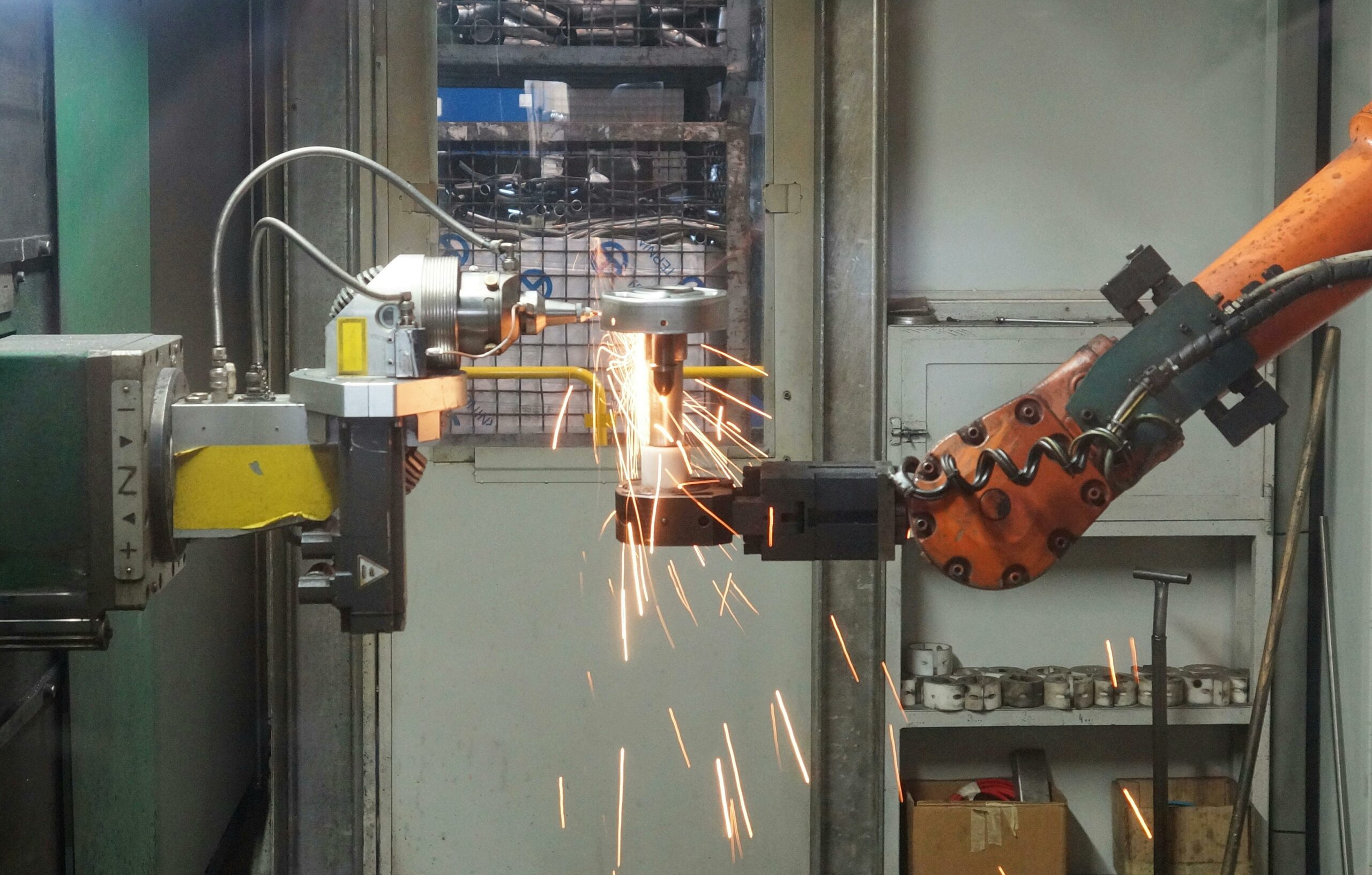
AI-powered automation is revolutionizing welding and fabrication by enabling high-precision, data‑driven control over processes and in‑line quality inspection. Combining robotics, sensor fusion, machine vision, and deep learning ensures weld consistency, boosts throughput, and addresses the global shortage of skilled welders .
Core Technologies
AI‑Guided Weld Path & Parameter Control
Cobots now autonomously optimize torch path, current, voltage, and speed in response to joint geometry and material changes mavenlazer.com+2bluebayautomation.com+2weldinginfo.org+2.
Real‑Time Vision and Sensor Monitoring
Vision systems (HDR, NIR), combined with infrared and ultrasonic sensors, continuously inspect weld formation, pool dynamics, spatter, and heat profiles, enabling immediate parameter adjustments en.wikipedia.org.
Multimodal Defect Detection
Deep learning models ingest audio, video, and electrical signatures to detect defects—often with AUROC ≥ 0.92 in live settings novarctech.com+5arxiv.org+5easyodm.tech+5. Signature Image Processing analyzes arc stability and process parameters maintworld.com+13en.wikipedia.org+13en.wikipedia.org+13.
Predictive Maintenance & Production Scheduling
AI predicts tool failure from vibration, current, and temperature, reducing unplanned downtime. It also optimizes scheduling to balance load and maintain quality .
Industry Applications
- Pipeline & Heavy Structural Welding: Novarc’s Spool Welding Robot with NovEye™ Autonomy achieves x‑ray quality welds autonomously automationmag.com+2novarctech.com+2novarctech.com+2.
- Manufacturing & Automotive: Tesla uses AI‑driven welding in Gigafactories; Megmeet and Kemppi offer cobot+vision solutions with 80% precision gains maintworld.com+2megmeet-welding.com+2megmeet-welding.com+2.
- Aerospace & Defense: Wolf Robotics and BAE Systems co‑developed agile welding cells for armored vehicle hulls en.wikipedia.org+1megmeet-welding.com+1.
Academic & R&D Advances
- Deep learning for GMAW quality prediction: recurrent nets interpret voltage/current data to predict quality in real‑time arxiv.org+1megmeet-welding.com+1.
- Unsupervised multi-modal defect detection: audio+video deep models achieve AUC ~0.92 across many defect types arxiv.org.
- CNN-enabled ultrasonic additive manufacturing QA: thermal-image models reach >97% accuracy in defect classification arxiv.org.
Benefits
- Precision & Consistency: AI reduces welding defects and rework, ensuring uniform quality weldinginfo.org+10bluebayautomation.com+10megmeet-welding.com+10.
- Productivity & Cost Savings: Cobots handle repetitive tasks, freeing skilled welders and achieving faster ROI (6–18 months typical) .
- Safety & Workforce Optimization: Robots handle hazardous work; AI‑based VR training accelerates skill acquisition .
- Reduced Downtime: Predictive tools minimize disruptions and maintenance surprises .
Challenges
- Data Requirements: Large, diverse datasets are needed to train robust models yenra.com+10megmeet-welding.com+10arxiv.org+10.
- System Integration: Merging AI with PLCs, cobots, sensors, and IoT demands deep expertise .
- Cost Barriers: Setup and sensor investments may deter smaller shops; ROI must be carefully estimated .
- Workforce Transition: Reskilling welders as robot supervisors poses organizational challenges .
- Safety & Standards: Complex regulatory approvals are required for AI‑driven autonomous welding .
Future Directions
- Fully Autonomous Cells: Vision‑driven cobots handling multi‑pass, multi‑layer welds with zero operator presence maintworld.com+4megmeet-welding.com+4novarctech.com+4.
- Smart Factory Integration: Welding stations integrated in Industry 4.0 ecosystems, enabling traceability and cross‑process quality control .
- Advanced Sensor Fusion: Combining optical, thermal, acoustic, ultrasonic, and electrical data streams for ultra-precise QC .
- Edge AI & Continual Learning: On‑device AI that evolves with process drift and new defect types arxiv.org.
- Human–Robot Collaboration: Cobots support skilled welders in complex tasks, while robots automatically handle standardized welds easyodm.tech+9bluebayautomation.com+9maintworld.com+9.
Conclusion
AI-driven welding systems represent a transformative leap in fabrication—enhancing precision, productivity, and safety while addressing the global skills shortage. Though challenges remain in data, costs, and integration, the benefits of high-quality, efficient production are undeniable. As sensor and AI tech continue maturing, we’re approaching a future where welding is a seamless, intelligent process—powered by machines, guided by data, and overseen by humans. This synergy will define next‑gen manufacturing excellence.